
What Makes Arizona’s Sunsets so Beautiful?
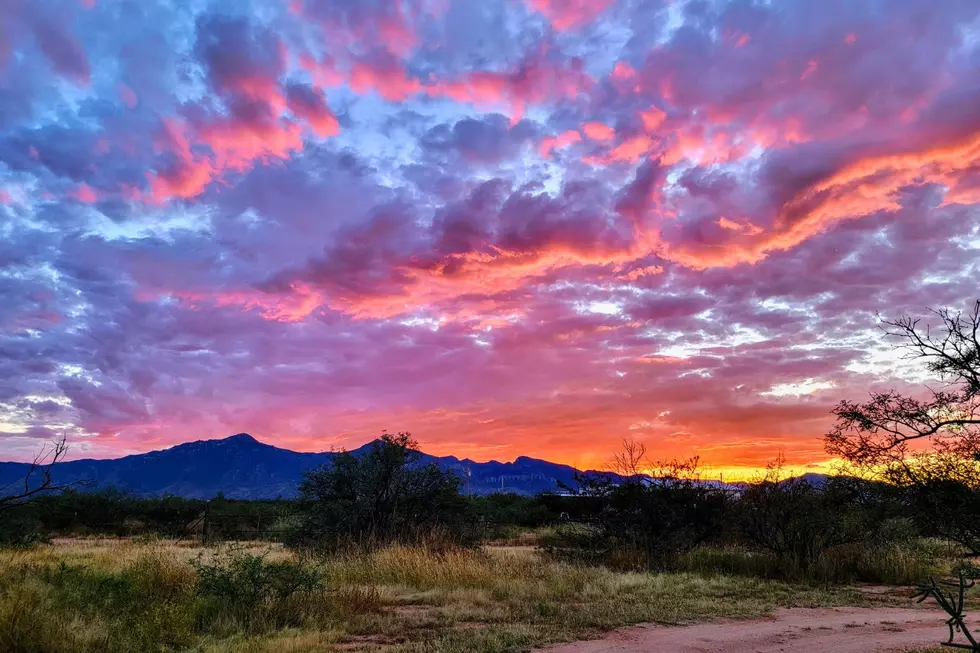
Arizona is home to some of the most awe-inspiring sunsets in the country. Oranges, pinks, and reds fill the skies every evening before the sun finishes its journey below the horizon. With such colorful sunsets, it's no wonder locals' galleries are full of pictures of the sky! So, what's the science behind our gorgeous sunset?


The Sun
Sunlight contains every wavelength of visible color. When it reaches our atmosphere, it is filtered, and only some of the colors reach us due to a process known as Rayleigh scattering. Rayleigh scattering is what happens when light hits a variety of particles and gases that cause it to change direction. Longer light wavelengths get through the atmospheric particles, while shorter wavelengths are scattered.
According to The Center of Scientific Education, red and orange light have longer wavelengths, while blue light has a shorter wavelength. During the day, the wavelengths of blue light are dispersed everywhere due to Rayleigh scattering, making the sky appear blue. When the sun crests the horizon, its angles change, and the blue cannot reach through the atmosphere as easily.
RELATED: The Legacy of Pluto's Discovery At Lowell Observatory Here in Arizona

Red and Orange light
Red and orange lights have significantly longer wavelegnths then blue light does. Due to these longer wavelengths, red and orange do not scatter as easily. However, when the sun makes its way behind the mountains, the blue light cannot reach through the atmosphere, and red and orange fill the air instead.
Cloud coverage can create unique sunsets as well! According to the National Oceanic and Atmospheric Association, when light passes through moisture or a water droplet, it slows down and bends, separating the different color wavelengths. When light goes through high-altitude clouds or moisture, the wavelength is changed (like what happens when you see a rainbow), which can result in the sky bursting with unique pastels, bright reds, purples, and sometimes even a stunning bright pink.
READ: What Wildlife Comes Alive At Night In The Arizona Desert?
Climate
Arizona's dry, arid climate also helps shape the way our sunsets are formed. The desert air contains fewer water droplets then othe climates, allowing waves of light to pass through with less diffusion, sharpening warmer colors like orange. Our high altitude also means the light doesn't have to travel as far for us to see it.
Molecules like dust and aerosol, common air particles in Arizona, also play a role in boosting the vivid colors we see in the evening. Tiny air particles like dust scatter light without diffusing it, helping create the decorative skies of Arizona.

The way the lightwaves from the sun hit the atmosphere and Arizona's unique climate work in harmony to create beautiful sunsets that locals look forward to every evening. As dusk settles in this evening, take a moment to sit outside and watch as the colors change in the sky. You won't be disappointed!
CONTINUE READING: How Dark Sky Cities Enhance Night Sky Views In Arizona
How Many of Arizona's Official State Symbols Do YOU Know?
Gallery Credit: Val Davidson/TSM
Summer Emergency in Arizona? Here’s What Locals Know
Gallery Credit: Val Davidson/TSM
More From KWCD Country